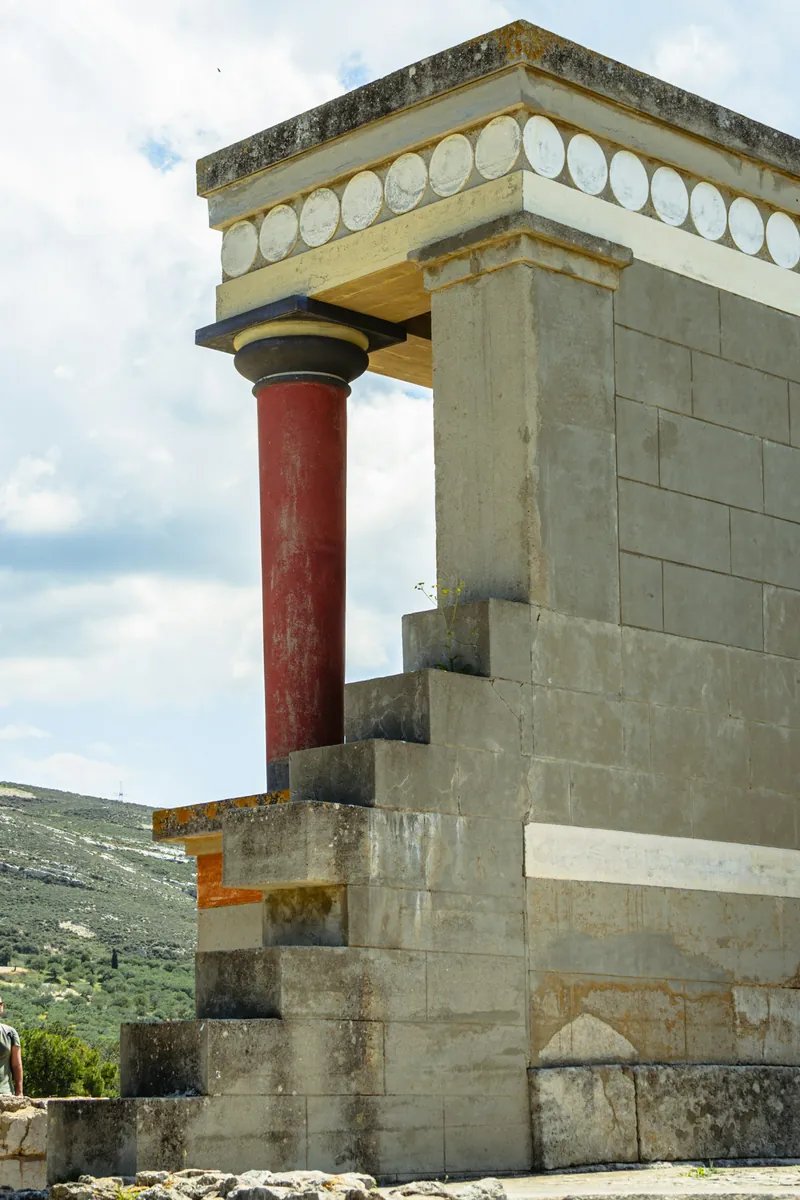
The Palace of Knossos is the largest Bronze Age site on Crete and the ceremonial heart of the Minoans — the first advanced civilisation in Europe. A first palace rose here around 1900 BC; rebuilt grander after an earthquake, it flourished from roughly 1700 to 1450 BC as a sprawling complex of courts, workshops, storerooms and frescoed halls, its winding, multi-storey plan so labyrinthine that later Greeks wove it into the myth of King Minos, the Minotaur and the maze built by Daedalus.
What you walk through today owes its vivid red-and-black columns and reconstructed halls to Sir Arthur Evans, who excavated the site from 1900 and rebuilt parts of it in concrete to show how he believed it once looked. The result is unlike any other ruin in Greece: the Throne Room with its gypsum throne and griffin frescoes, the Grand Staircase, the Hall of the Double Axes and the dolphin fresco of the Queen's apartments all stand reconstructed where you can see them. The original frescoes and finds are kept a few kilometres away in the Heraklion Archaeological Museum.
Knossos sits on the Kephala hill about five kilometres south of Heraklion, easily reached by city bus or taxi. It is Crete's busiest monument, which is exactly why the on-the-day queue can cost you an hour in the sun. We handle the ticketing in English and reserve your entry for the date you choose, so you can give that hour to the palace instead of the line.