Walk the throne room of Europe's first civilisation at the Palace of Knossos
The great Bronze Age palace of the Minoans on the hill above Heraklion, the legendary labyrinth of King Minos and the Minotaur.
Book the skip-the-line palace tour- 1900 BC First palace built
- Minoan Europe's first civilisation
- 1M+ Visitors a year
- 5 km South of Heraklion
Tickets and tours for Knossos
Compare the best-rated ways to visit, check live availability and book in a few taps.
- Top pick
Knossos: Knossos Palace Skip-the-Line Guided Walking Tour
A 1.5-hour small-group walk with a licensed guide and the palace entry ticket included, with optional Heraklion pickup and museum add-on.
From US$99Check availability ↗ Knossos Palace Skip-the-Line Ticket & Private Guided Tour
A private visit with a licensed archaeologist and a skip-the-line entry ticket to the palace.
From US$234Check availability ↗Crete: Knossos Palace & Heraklion Guided Tour
A coach day with pickup, a guided tour of Knossos and free time in Heraklion; palace and museum entrance fees are paid on top.
From US$37Check availability ↗Crete: Knossos Palace, Winery & Olive Oil Tour with Lunch
A 6-hour day with hotel pickup, a Knossos stop, wine and olive oil tastings and a Cretan lunch; the palace ticket is extra.
From US$116Check availability ↗Crete: Knossos Palace Entry Ticket with Optional Audio Guide
A timed entry ticket to the archaeological site with an optional self-guided audio tour; non-refundable.
From US$29Check availability ↗
More things to do nearby
About Knossos
The Palace of Knossos is the largest Bronze Age site on Crete and the ceremonial heart of the Minoans — the first advanced civilisation in Europe. A first palace rose here around 1900 BC; rebuilt grander after an earthquake, it flourished from roughly 1700 to 1450 BC as a sprawling complex of courts, workshops, storerooms and frescoed halls, its winding, multi-storey plan so labyrinthine that later Greeks wove it into the myth of King Minos, the Minotaur and the maze built by Daedalus.
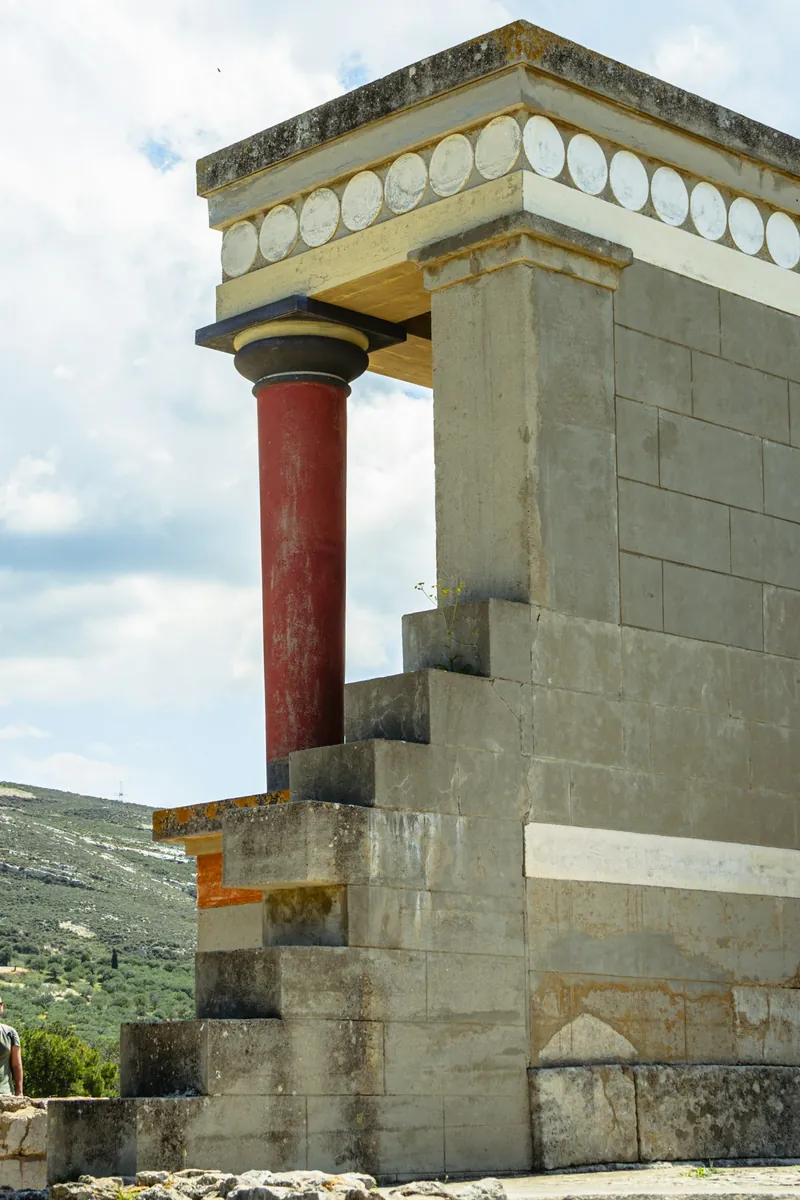
What you walk through today owes its vivid red-and-black columns and reconstructed halls to Sir Arthur Evans, who excavated the site from 1900 and rebuilt parts of it in concrete to show how he believed it once looked. The result is unlike any other ruin in Greece: the Throne Room with its gypsum throne and griffin frescoes, the Grand Staircase, the Hall of the Double Axes and the dolphin fresco of the Queen's apartments all stand reconstructed where you can see them. The original frescoes and finds are kept a few kilometres away in the Heraklion Archaeological Museum.
Knossos sits on the Kephala hill about five kilometres south of Heraklion, easily reached by city bus or taxi. It is Crete's busiest monument, which is exactly why the on-the-day queue can cost you an hour in the sun.
Practical information
- Opening hours
- Open daily, year-round. Summer (roughly April–October) approx. 08:00–20:00; winter (November–March) shorter daytime hours, often around 08:30–17:00. Last entry is about 30 minutes before closing. Hours are set by the operator and change seasonally and on public holidays — confirm on the day of your visit.
- Address
- Knossos, 714 09, Heraklion, Crete, Greece.
- Getting there
- Knossos is about 5 km south of Heraklion. From the city centre and the port, local bus line 2 runs frequently to the Knossos terminus right by the entrance in about 20 minutes; a taxi takes around 15 minutes. If you drive, there is paid parking near the site. Many visitors pair it with the Heraklion Archaeological Museum in town, where the original frescoes are kept.
- Accessibility
- An open Bronze Age site on a hill, with uneven ground, gravel paths, ramps, gypsum steps and raised wooden walkways across the ruins. Sun exposure is high and shade is limited. Sturdy shoes, a hat and water are strongly recommended; visitors with limited mobility should allow extra time and note that some upper levels are reached only by steps.
- Bag policy
- Day bags are fine. There is no large-luggage storage on site, so leave suitcases at your accommodation or in Heraklion.
- Photography
- Personal photography is welcome across the site. Tripods and professional equipment may require permission; some display areas post their own signs.
Plan your visit
Practical guides written by our travel team
The Best Time to Visit Knossos
When to arrive to beat the cruise crowds and the Cretan heat, the best months to come, and how to time an open-air walk through the Minoan palace.
How to Get to Knossos from Heraklion
The city bus, taxi and driving options for the short hop from Heraklion to the Minoan palace, with journey times and where to catch each one.
What to See at Knossos
The Throne Room, the Grand Staircase, the storage magazines and the reconstructed North Entrance — a guide to the highlights of the Minoan palace.
Frequently asked
How do I get to Knossos from Heraklion?
Knossos is about 5 km south of the city. Local bus line 2 runs frequently from central Heraklion and the port to the Knossos terminus by the entrance in around 20 minutes; a taxi takes about 15 minutes. There is paid parking near the site if you drive.
How long should I allow for the visit?
Most visitors spend about 1.5 to 2 hours on site. The layout is genuinely labyrinthine and rewards an unhurried walk; a guide or the audio history helps the reconstructed halls make sense. Allow extra time in summer for the heat and the walk from the bus or car park.
What is the connection to the Minotaur and the labyrinth?
Knossos is the palace later Greeks linked to the legend of King Minos, the half-bull Minotaur, and the labyrinth built by Daedalus to contain it — the maze Theseus escaped with Ariadne's thread. The myth almost certainly grew from the palace's vast, winding, multi-storey plan, which to later visitors felt like a maze.
Should I also visit the Heraklion Archaeological Museum?
If you can, yes. The famous original frescoes from Knossos — the Bull-Leaping fresco, the Prince of the Lilies, the dolphins — and the Minoan treasures are kept in the Heraklion Archaeological Museum in town, while the site itself shows reconstructions in place. Seeing both gives you the complete picture; they make a natural half-day pairing.
When is the best time to visit?
Right at opening or in the last couple of hours before closing, outside the July–August peak. Mid-morning to early afternoon is the busiest and hottest stretch, when Heraklion coaches and cruise groups overlap. Because your ticket is for the date you choose, you can simply pick a cooler, quieter day.
Is Knossos good for children?
Yes — the myth of the Minotaur and the labyrinth captures most children's imaginations, and the bright reconstructed columns, the throne and the storage jars bring the Bronze Age to life. It's an open site with uneven ground and steps, so bring sun protection and water and keep an eye on little ones near the walkways and drops.
Is the site wheelchair accessible?
Partly. Knossos is an open Bronze Age site on a hill with gravel paths, ramps, gypsum steps and raised wooden walkways; the ground is uneven and some upper levels are reached only by steps. Visitors with limited mobility can see a good deal of the site but should allow extra time and expect difficult surfaces in places.
Is Knossos open all year?
Yes — the site is open daily, year-round. Only the daily hours change with the season: longer in summer (roughly 08:00–20:00) and shorter in winter, with last entry about 30 minutes before closing. Hours can change on public holidays, so confirm on the day.
How does booking work on this site?
This site is an independent visitor guide to Knossos. When you choose a ticket or tour, you book it directly with GetYourGuide, which takes the payment, issues the ticket and handles any changes or cancellations. We may earn a commission when you book, at no extra cost to you.